We exited the park Sunday afternoon about 2:30 by the less-traveled east gate.
This was the big day when the moon would pass directly between the Earth and sun in a rare solar eclipse. In most eclipses, the apparent size of the moon matches the disk of the sun so only the sun's billowing corona glows around the darkened center. Because the moon is at its outermost point, or apogee, in its slightly oval orbit, it appears a bit smaller and blocks less of the sun. This was to be a "ring of fire" or annular eclipse.
Our goal was to be on the eastern shore of Lake Tahoe for the solar eclipse, but we were hobbled by the stuck clutch on the Kawasaki Ninja. Without a clutch, mountain riding would require Marty to rely on brakes, not downshifting, in tight curves and downhill runs. Because brakes are prone to overheat and fade when used too heavily, this cut his margin of safety. We had to ride slower.
The ride was, as we'd come to expect, both beautiful and full of "twisties." The road climbed steadily to the highest elevation we'd been to on the entire trip, 9,900 feet. Despite the relatively dry winter, we saw huge snow banks. At one point I rode past a family having a snowball fight. We came upon an accident scene where park rangers were blocking what little traffic there was. Marty made a slow U-turn and looped back a half mile while I explained that he would not be able to stop and restart on the uphill grade. The ranger understood and let him pass smoothly by.
The exit checkpoint sits at on a treeless windswept ridge just before the road descends from the high plateau. The road down is excellent quality with two lanes in both directions and broad sweeping curves. It is the kind of run that forces you to shout 'Wheeeeee!' but you really can't keep that up for eight or so miles. The road builders did skimp a bit on guard rails, there were hardly any until the last mile or so when brakes would be red hot and failing. As a result the view was completely unobstructed most of the way down. There was next to nothing between me and and 2,500 foot drop.
Back at "normal" 5,000 foot elevation, we turned north. The sky was mostly overcast and there were even a few sprinkles on the windshield. I checked the hourly forecast for Lake Tahoe and it showed cloudless skies for the rest of the day. The lake sits on the west side of a tall north-south line of continuous mountains. In order to view the eclipse we would need to make it at least to the summit. Thirty miles shy of the turn west, my heart sank. We were faced with another road construction project. The sign told us to expect 20 minute delays as we rolled to a halt behind a long line of cars and RVs.
Tuesday, May 22, 2012

Clutch
About midway back to Yosemite Valley, we came to the turnoff for the road to Glacier Point which towers directly above our campsite. This 17 mile side trip across a forest plateau pays off at the very end twice -- first with views of the Little Yosemite Valley to the south then with a "holy crap!" overlook of half dome, Nevada Falls, and a full panoramic sweep of the Yosemite Valley.
Time was getting short, we faced a noon deadline to be out of our campsite. We joked about excuses we could give to the ranger such as a mechanical problem with the bikes. Soon after the turn onto the main road, we weingressing down toward the tunnel when I heard Marty shout "What the heck?" as he swerved and slowed rapidly. He had been coasting with the clutch lever pulled in and the bike in a low gear so he could slip the clutch to slow down. The clutch had suddenly engaged on its own. We pulled over. Our first thought was that the clutch cable had snapped, an easy fix. Unfortunately, this was to be. Something inside the clutch case was broken.
A car (or bike) with a manual transmission can be shifted from gear to gear without a clutch. The trick is to find the right throttle setting that takes the pressure off the gears, neither accelerating nor engine braking. The shift may be a bit clunky, but you can still move on. The bigger challenge is how to get moving from a dead stop. Marty's bike is light and low enough that a rider can push with his feet to a few mph, just fast enough to jam the bike into first gear and ride onward. With the clutch locked, stopping is also a problem. The solution is simple: don't stop. I would ride ahead of him, come to a full stop at stop signs, then slide into the intersection blocking cross traffic momentarily while he slid by at a slow speed.
We managed the six miles to our campsite arriving about 1:15, well after the noon checkout time. The next campers, two young men, were already set up on the site. We apologized for the inconvenience and broke camp. As we loaded our bikes, a second van pulled into the same site with two more guys. I found myself listening in on their fascinating conversation. They are a group of rock climbers who were about to climb the shear rock face of El Capitan! I didn't understand half of their jargon or slang, but I got the gist of the discussion. Especially when their voices went low as they spoke of reaching places where they are sure they cannot move in any direction, but do it anyway.
I gave Marty a push to get his fully loaded bike rolling and he kicked it into first and puttered away. I ran back to my bike and soon caught up. As we left the campground, I told the ranger (the same fellow from Minnesota) about our misadventure with the clutch and we hit the road.
Free Ride
Sunday morning we were on the bikes at 7:30 for a fun ride with none of our saddlebags, camping gear, tools, or any other burden. My bike is not a "cruiser" with the larger front tire, fairings, and permanently fixed saddlebags. Mine is easily 100 pounds lighter than the Road Kings and such while still having the 96 cubic inch engine, six speed gearbox, and a rugged frame suitable for long voyages. And I can strip it down by removing the saddlebags and let it run free.
Our primary target was the Mariposa Grove of giant redwoods. From the North Pines campsite, the grove is an hour south, just past the final turn to the park entrance we had come in through on Saturday. Not only were we free of baggage, but the roads were empty at that hour. I have often said that riding a motorcycle is as close as you can get to flying without leaving the ground. On this run I felt like a peregrine falcon swooping and diving through Yosemite.
Near the south entrance there lie a gas station, a visitor center where permits are issued for the more advanced trails and rock climbing, and a classic white clapboard hotel named the . We topped off the tanks for $5.70 per gallon then headed into the hotel for breakfast. We both ordered eggs Benedict and the hollandaise sauce had a surprising peppery zing to it, about as spicy as medium salsa. We both really liked it, but I commented to the waiter that most guests appear to be older and have more docile tastes. I supposed that since the continental buffet is included with the room bed-and-breakfast style, few guests order from the menu. He checked with the chef and returned with a bottle of "Plant Sauce" telling us the chef had added this great stuff to the hollandaise today.

The previous day on our trail hike we came across this handsome fellow.
We showed it to the waiter who called over a bus boy who knew more about snakes and told us this one is a King snake. They eat rattlesnakes, which are abundant because the previous two winters were wetter than usual so there were more rodents and so on up the food chain. There is a nmemonic that is supposed to help distinguish between venomous Coral snakes that have a red stripe between yellow bands. King snakes are harmless to people, so now I will remember red-touch-black is okay and red-touch-yellow is not.

After breakfast, we rode the last few miles to the Mariposa Grove. Marty asked a ranger where to find the very largest sequoia and she told us that was the Grizzly Giant and it was .8 miles up a hiking trail from the parking lot. We were both still a bit sore from Saturday's climb to the Lower Falls, but we ignored the tender muscles and headed on up. Along the way there was a tree with an arched tunnel cut through large enough to easily fit a dozen people inside. There were also several fallen trunks about six to ten feet in diameter. Some showed the scars from fires and one had a four foot wide section cut out so the trail passed through. After photos with the great tree -- which is largest in girth, but limited in height -- we returned to the bikes and headed north.
Our primary target was the Mariposa Grove of giant redwoods. From the North Pines campsite, the grove is an hour south, just past the final turn to the park entrance we had come in through on Saturday. Not only were we free of baggage, but the roads were empty at that hour. I have often said that riding a motorcycle is as close as you can get to flying without leaving the ground. On this run I felt like a peregrine falcon swooping and diving through Yosemite.
Near the south entrance there lie a gas station, a visitor center where permits are issued for the more advanced trails and rock climbing, and a classic white clapboard hotel named the . We topped off the tanks for $5.70 per gallon then headed into the hotel for breakfast. We both ordered eggs Benedict and the hollandaise sauce had a surprising peppery zing to it, about as spicy as medium salsa. We both really liked it, but I commented to the waiter that most guests appear to be older and have more docile tastes. I supposed that since the continental buffet is included with the room bed-and-breakfast style, few guests order from the menu. He checked with the chef and returned with a bottle of "Plant Sauce" telling us the chef had added this great stuff to the hollandaise today.

The previous day on our trail hike we came across this handsome fellow.
We showed it to the waiter who called over a bus boy who knew more about snakes and told us this one is a King snake. They eat rattlesnakes, which are abundant because the previous two winters were wetter than usual so there were more rodents and so on up the food chain. There is a nmemonic that is supposed to help distinguish between venomous Coral snakes that have a red stripe between yellow bands. King snakes are harmless to people, so now I will remember red-touch-black is okay and red-touch-yellow is not.

Monday, May 21, 2012
Into Yosemite
I have been given a wonderful gift: the ability to fall asleep quickly, to sleep deeply through an avalanche, and to fully recharge in about six hours. I wake in the morning at my finest and ready to start the day. Marty is more of a typical twenty year old who pushes it later at night and sleeps later in the morning. So far this is working out really well because it gives each of us a little "me time" at the end of his day and at the beginning of mine.
Saturday morning, I woke early in the Motel 6 bed with the sound of heavy trucks rolling by on the freeway a hundred yards (or less) across the parking lot. I went to the lobby and signed in for Wi-Fi service for two hours of blogging, email, and photo uploads while Marty slept.
Comedian Steven Wright has a funny one-liner "It's a small world, but I would hate to paint it." While I was in the lobby, an older man came in and we struck up a conversation. It turned out that he is a tour guide at the Hoover Dam. Our tour guide two days prior was named Charlie and had mentioned that he retired from the phone company in Orlando. When I told this man at the Motel 6 our tour guide was Charlie, he immediately said "He's a great guy. He came from Orlando and worked for the phone company."
We loaded the bikes, by now this ritual was becoming routine and well practiced. We know exactly how each piece fits into the puzzle for a snug and secure ride. After a McDonald's breakfast, we set off.
In the central plains states, agriculture has a monotonous repetition of row crops. If you are passing through a corn growing area, you will see mile upon mile of cornfield. Likewise with wheat. Two years ago when I rode across western North Dakota in August, I was stunned by the beauty of mile upon mile of sunflowers all facing the sun. But in the Imperial Valley, it seems that each farm is distinct from the next. As you drive by, the view shifts from strawberry field to corn, apple orchards, radishes, grapes and every imaginable type of produce. It makes for a far more interesting ride as you try to guess "what the heck are they growing?"

We refueled in Madera and headed east into rolling ranch country. No more row crops, just hayfields, horse farms, and cattle. We turned to the northeast on an exhilarating road that ran past a reservoir, swept by gorgeous ranches, and climbed to 4,000 feet. Soon the scrubbier foothills turned to pine covered mountains as we road higher and higher. We had an enormous amount of fun even before we got to the south gate of Yosemite National Park. At the gate we showed the annual pass I had bought at the Grand Canyon and breezed on through. The twisting climb continued up to an elevation approaching 9,000 feet then we descended through a long tunnel and emerged into the Yosemite Valley.
I had reserved a campsite by the Merced River in the campground that is the furthest into the valley. My reservation was for both Friday and Saturday nights. When we arrived a few minutes before 3:00 on Saturday, the ranger at the gate said we were just minutes away from losing the site. We chatted with the ranger and ... small world once again ... he was from Shakopee, Minnesota just a few miles from our home town of Chaska.
We decided to take a trail hike up to the base of the Lower Falls and I shot this short video. Words cannot begin to describe the majesty of the sheer stone faces with numerous waterfalls that cascade from like lace curtains. It hardly seems fair to see a spectacle like this when you are a mile up and hardly have any breath to spare. The hike took us up about 1,200 feet above the valley floor -- a little over 100 stories. And even at that we were less than 1/3 of the way to the top.
I have a personal preference to NEVER cook while camping. For one thing, food means cooking, dishes, coolers, stoves, dishrags and soap, and so on. As a second issue, food attracts critters. The national parks are filled with signs admonishing campers to store food in locked bear-proof steel cabinets, don't cook in tents because the smell will attract bears, to place trash in vault-like trash containers, and to never leave food in cars because bears will tear doors off to get at it. Third, when you add it all up, cooking at a campsite isn't really all that cheap. Why bother with the bulk, the danger, and the expense when you can eat a restaurant?
We cleaned up after our hike and headed for the Ahwanee Hotel. The dining room bears a striking resemblance to the Great Hall of Hogwarts Academy including the floating candles but sans the sorting hat.
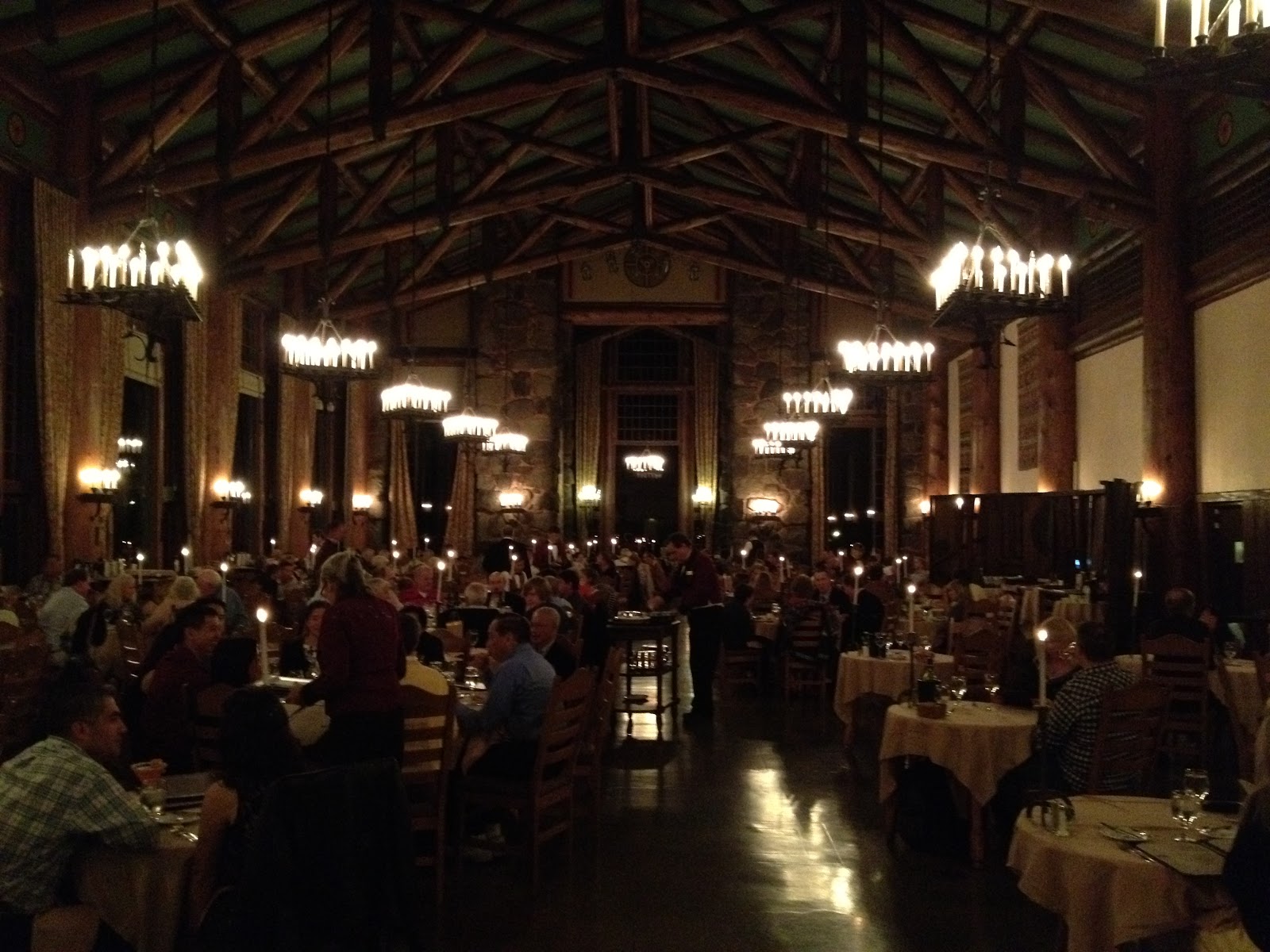
Our waiter was Adrian and his name tag showed his hometown as Transylvania, Romania. He told a hilarious story of the Halloween when a bat found its way in. Another staff member calmly remarked "Oh That's just Adrian." But because vampires cannot be photographed I have proof of his humanity.


Exhaustion
By late Friday afternoon, we had made it to the Monterey Peninsula. We ran through Carmel, past the golf course at Pebble Beach and into Monterey. After my iPhone's screen turned into a fractured mess, I had made a 6:00 appointment at the Apple store in Monterey. We arrived early and had to wait for our appointment. When I bought this phone I purchased the Apple Care Plus package knowing that it was a bad bet on Apple's part. For $49 I had a new phone. But the process of restoring my apps and data from iCloud backup took a lot longer than I had anticipated.
We lost more almost two hours to the phone swap. Supper was a slice of pizza and a greek salad at a place in the mall with free Wi-Fi so the iPhone restoration process could complete while we ate. We sat next to a table full of ten year olds. I thought that at least two of them needed their Ritalin dose to be cranked up a few milligrams.
By now I was weary. Really weary. Camping on the beach at Ventura seemed a lot more distant than only fourteen hours ago. I am a morning person; I had awakened before sunrise and was in the shower at 6:00 am. By 7:30 we were rolling west on the coastal freeway. There were two rest breaks at a Walmart and the mall in Monterey, but my 54 year old body was screaming "No mas! No mas!" We were at least four and a half hours short of our goal to camp in Yosemite.
We pressed eastward into the Imperial Valley until we reached Santa Nella. Marty still had the energy to ride onward, but I was wiped out and knew that we had already pushed too far for safety. We checked into a Motel 6 in Santa Nella and quickly fell asleep.
Coast
This is what an iPhone looks like after it has been run over by a pickup truck. As the screen shows, it still works.

Friday May 18 was planned to be an ambitious ride. Our original target was to spend Thursday night 30 miles west of Santa Barbara, but we had fallen short by an hour. So if we were still going to make it to Yosemite by dark, we needed an early start and for the day to go flawlessly. It didn't. But it was still a fantasy-come-true kind of day.
We first road west from Ventura past Santa Barbara. As we approached the northward turn, signs warned to beware of high winds in the canyon. The campground I had wanted to stay at the previous night may have looked great on a map, but it was also directly in the path of those canyon winds.

As we passed through Lompoc, I felt something hit the bottom of my right boot. I looked in the rear view mirror and saw something bounce to a halt in the road just before a pickup truck ran over it. I circled back and found my iPhone lying with a shattered face, but still working. It had vibrated loose from its cradle in my windshied.
We joined two other riders for a fun run through the terrain running toward Vandenberg AFB.

We missed a turn at San Luis Obispo and it turned out to be a wonderful mistake. Rather than circle back to the missed turn ("always forward" was our motto), we instead ran up to Atascadero and down highway 41 through another beautiful canyon run.

As we approached the Hearst Castle at San Simeon, we came across a beach where elephant seals gather by the hundreds at this time of year. Volunteers watch over the herd and give impromptu lessons about the seals to those who stop by. The area reeked with the musky odor of this mass of blubber.

We had put nearly 2,000 miles on the bikes since we left Denver on Sunday. At long last we came to the winding stretch of coastal highway that leads to Big Sur. The weather was perfect, traffic was light, and there were no trucks and very few RVs to stand between us and an amazing run.


Pacific
[As I write this, t is 3:00 am in Reno, Nevada on Monday, 21. My last post was written three days ago in the Imperial Valley of California. I am several days behind on the blog, but will do my best to catch up.]
Continuing Thursday's journey, we chose to avoid the famous traffic of Los Angeles by staying north of the Angeles National Forest. We continued west across the desert toward Palmdale then made our way southwest through the hills on Soledad Canyon Road.

There's a look that Marty gets in his eye when he is about to cut loose.


The ride through Soledad was both beautiful and thrilling. Between the weather, the scenery, and the 20% higher price of gasoline ... I don't understand how anyone can live in California and not own a motorcycle.
We stopped at Santa Clarita for our evening meal, we finally found an In-N-Out burger and stuffed ourselves with double cheese burgers and shakes. In California, fast food restaurants are required to post the calorie count of their menu items. Since we had never eaten lunch and had muscled our bikes across the desert, we earned every calorie we consumed.
From Santa Clarita, we continued due west to Ventura and the Pacific Ocean. Highway 120 through Santa Paula is lined with farms that grow avocados, strawberries, and other items that fill the produce section of our grocery back home.


As we approached the ocean, Marty made it clear that he would only get to see ONE Pacific sunset and he would not miss it stuck on the bike. We pulled off at Ventura and shot pictures as the sun disappeared behind the hills of Santa Barbara.

My goal for the day was a campground about 30 miles west of Santa Barbara, but the sun was down and we found an open spot in a county park named Faria Beach. We camped overnight sleeping 50 paces from the pounding surf.
Subscribe to:
Posts (Atom)